
What Is IPTV? How It Works and What It Really Costs in 2026
IPTV is television delivered over your internet connection instead of a cable or a dish. What it is, what it costs, and what it cannot do.
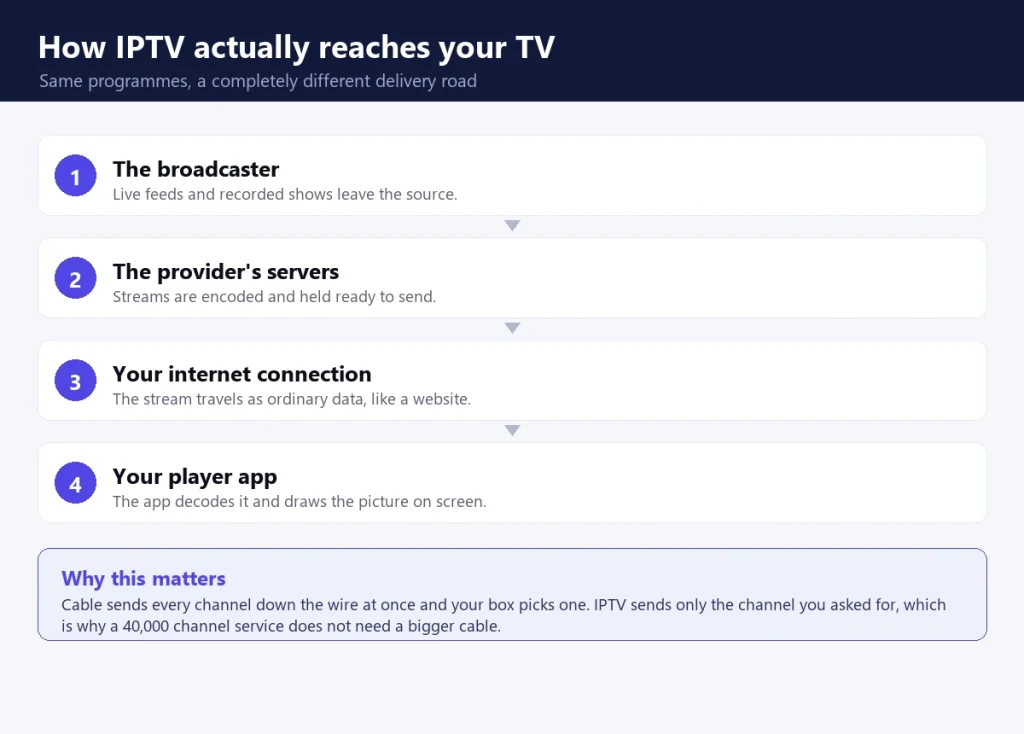
IPTV is television delivered over your internet connection instead of a cable or a dish. What it is, what it costs, and what it cannot do.
Key takeaways
- What is IPTV? Television delivered over your internet connection instead of a cable, a dish or an aerial.
- The technology is legal. Whether a provider is depends on the rights they hold, which is a fair question to ask them.
- Expect 5 to 15 dollars a month. Cable costs 8 to 12 times that for fewer channels.
- What is IPTV bad at? Surviving an unreliable connection, and it is the wrong buy if you only watch box sets.
iBoostv · Explainer
Television over your internet connection instead of a cable or a dish. What it is, what it costs, what it cannot do, and how to spot a provider worth paying.
Ask 10 people what is IPTV and you will get 10 answers, most of them wrong. It is not an app. It is not a pirate service. It is not a brand. IPTV stands for Internet Protocol Television, and it means exactly one thing: television delivered over your internet connection instead of a cable, a satellite dish or an aerial.
That is the whole idea. Everything else people argue about sits on top of it.
This guide answers what is IPTV properly, then covers the parts every other page skips: what it costs, what it cannot do, and how to tell a real provider from somebody reselling a line they do not own.
What is IPTV, in one sentence
IPTV is live TV that arrives the same way a website does.
When you load a page, your device asks a server for it and the server sends it back as data. IPTV works identically. Your player asks for BBC One or ESPN, the provider’s server sends that channel as a stream, and your screen draws it. No dish on the roof, no engineer, no coaxial cable running through the wall.
The reason the question what is IPTV confuses people is that the answer sounds like Netflix, and it is not Netflix. Netflix owns a library and rents it to you. An IPTV service carries live channels as they broadcast, including sport, news and local television. The technology is similar. What you get is not.
What is IPTV doing that cable is not?
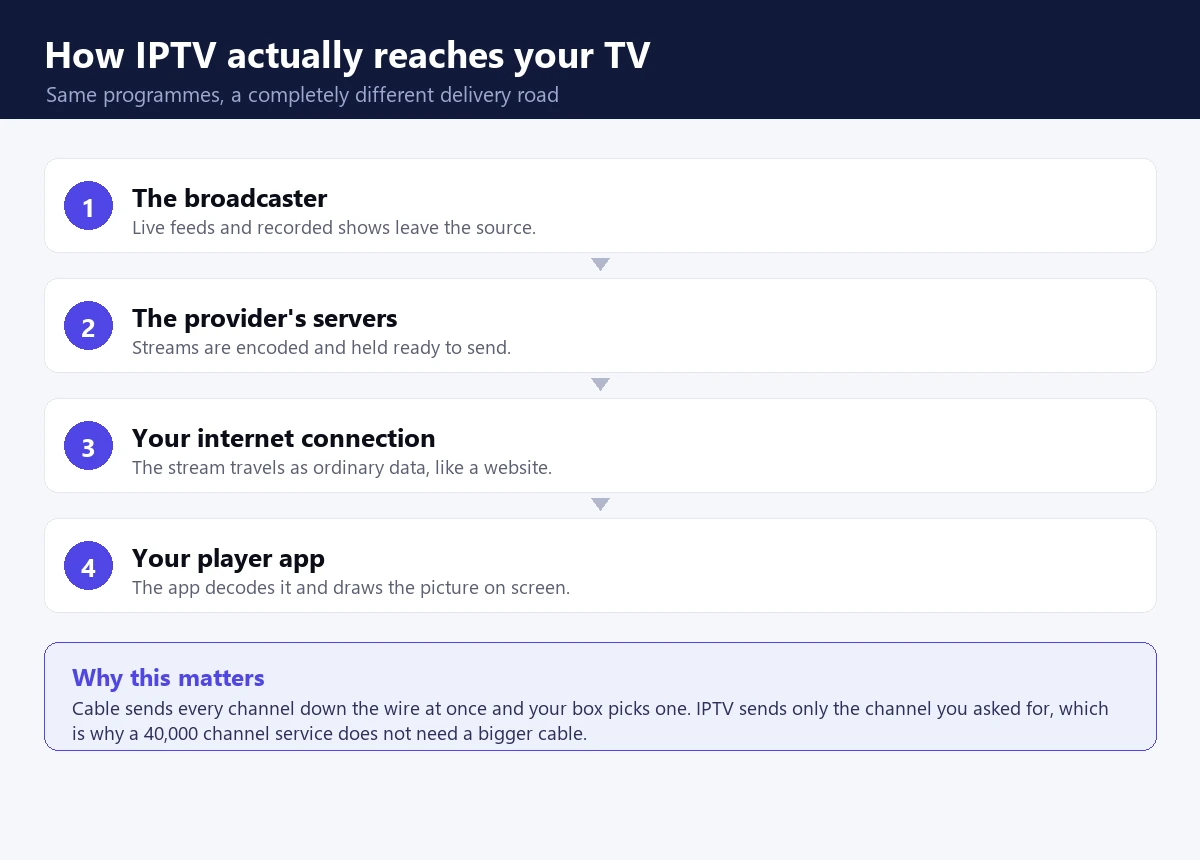
What is IPTV in 4 steps. The third one is your ordinary broadband, and nothing special is installed on your line.
Cable works by pushing every channel down the wire at the same time. Your box receives all 300 of them and displays whichever one you selected. It is a fire hose, and you drink from one small part of it.
IPTV sends only the channel you asked for. Nothing else travels. That single difference is why a service can offer 40,000 channels without needing a thicker cable, and it is also why your connection speed matters more than your channel count.
Live IPTV
Channels playing right now, exactly as they broadcast. This is the part cable customers recognise, and for most households it is the whole answer to what is IPTV for. Live sport is the single biggest driver.
Video on demand
Films and box sets you start whenever you like. Functionally the same experience as any streaming app, usually presented in a separate tab inside the player.
Time-shifted and catch-up TV
Programmes that already aired, held on the server for a few days so you can rewind to them. Support for this varies wildly between providers, and it is worth asking about before you pay.
What is IPTV not? Three things people confuse it with
Most of the bad advice about what is IPTV comes from mixing these three up.
It is not an app. IPTV Smarters Pro, IBO Player and TiviMate are players, and people talk about them as though they were the service. They are empty windows. Asking what is IPTV by pointing at one of those apps is like asking what television is by pointing at a remote control.
It is not a VPN. A VPN hides where your connection comes from. It carries no channels and provides no content. Some people use one alongside IPTV because their internet provider blocks portal addresses, but the two do completely different jobs.
It is not an M3U link. An M3U file is just a list of stream addresses in a text file. It is one of the two ways a provider hands you your channels, the other being an Xtream Codes login. The list is not the service any more than a menu is a meal.
Get those three separated in your head and the rest of the subject becomes straightforward.
Is IPTV legal in the USA?
The technology is completely legal. IPTV is a delivery method, in the same way that email is a delivery method, and nobody has ever been prosecuted for using an internet protocol.
What matters is the service you subscribe to. A provider that holds distribution rights for the channels it sells is operating legally, and watching it is legal. A provider that does not hold those rights is not, and that is true whether you watch it through IPTV, a browser or a satellite card.
So the honest answer to is IPTV legal in the USA is yes, with a condition attached that has nothing to do with the technology. Ask any provider directly what they are licensed to carry. A real one answers. That single question filters out more bad services than any review site.
What is IPTV: the short answers
If you skipped to the bottom, this is the whole article in 8 lines.
What is IPTV? Television delivered over your internet connection instead of a cable, dish or aerial.
What is IPTV short for? Internet Protocol Television. The protocol part is the same one that carries every website you visit.
Is it legal? The technology is. Whether a given provider is depends on the rights they hold, which is a question you should ask them directly.
What does it cost? Between $5 and $15 a month from anyone running real servers. Cable costs 8 to 12 times that.
What is IPTV going to need? A 25 Mbps connection, a device you already own, a free player app and one paid subscription.
Does it include Netflix? No. Anyone saying otherwise is not being honest with you.
What is IPTV bad at? Surviving an unreliable internet connection, and it will not replace an on demand library if live TV is not what you watch.
Who is it for? People who watch live sport, news or foreign channels and object to the cable bill.
Is IPTV free to watch?
There are free IPTV playlists, and they exist legitimately. Thousands of channels around the world broadcast free to air and publish public streams, which is where projects like the open IPTV playlist collections get their lists.
They are also unreliable in a specific way. A free public stream has no service level behind it. It works until the source changes an address, and then it does not, and nobody fixes it because nobody is paid to. If you have ever loaded a free playlist and found half the channels dead within a fortnight, that is why.
The free players are a separate thing again. IPTV Smarters Pro, IBO Player and TiviMate all cost nothing to install. What they never include is the content. That gap is where most of the confusion around what is IPTV comes from: people install a free app, see an empty screen, and assume the app is broken.
What is IPTV going to cost you?
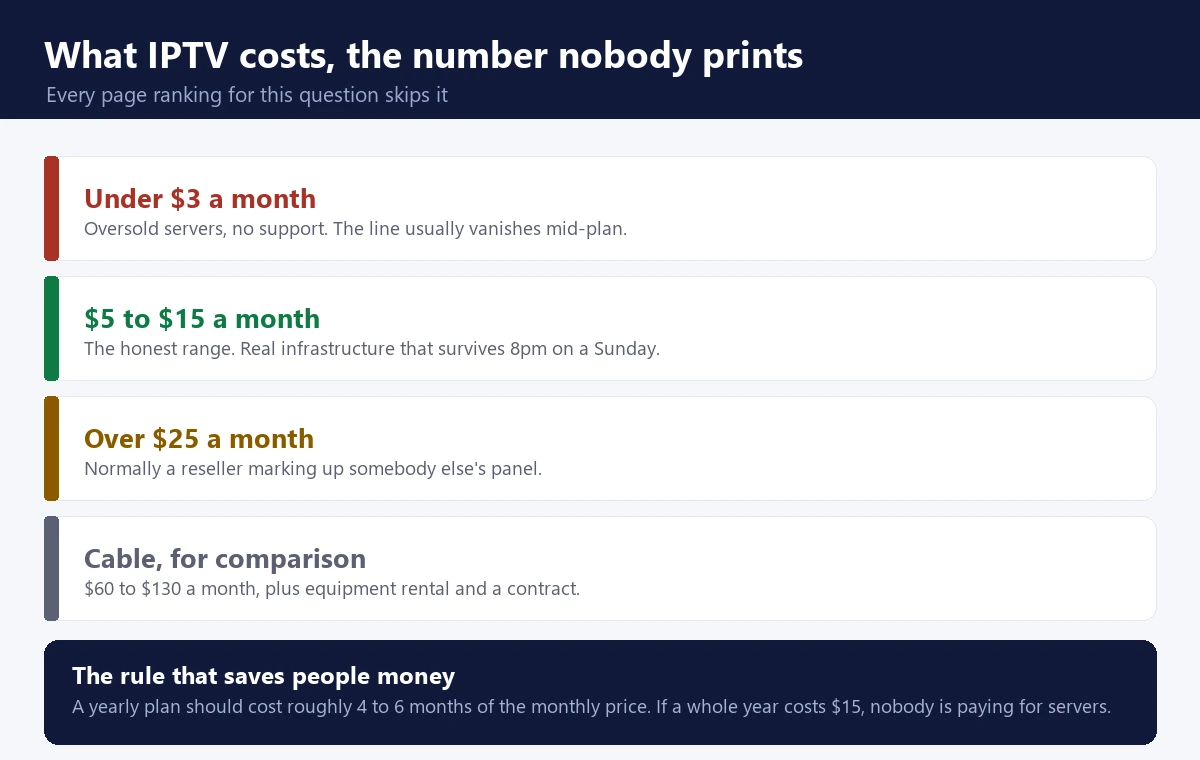
Every page ranking for what is IPTV avoids printing a number. Here is the real range.
Here is the part nobody prints. Prices sit in a narrow band, and the outliers tell you more than the average does.
Anything under $3 a month is a warning. Servers, bandwidth and support cost real money, and nobody is absorbing that out of kindness. Those lines are oversold, they stutter at peak time, and they have a habit of disappearing halfway through the term you paid for.
The honest range is $5 to $15 a month. iBoostv works out at $5.00 a month on the 12 month plan, or $13.99 for a single month if you want to test before committing. Above $25 you are usually paying a reseller’s markup on somebody else’s infrastructure.
One rule worth carrying with you. A yearly plan should cost roughly 4 to 6 months of the monthly price. If a full year is cheaper than 2 months, the maths does not work and neither will the service.
Is Netflix included in IPTV?
No, and any provider claiming otherwise is telling you something untrue.
Netflix, Disney+ and Prime Video are closed platforms. They are not channels that can be carried by anyone else, and they cannot be bundled into an IPTV subscription. What you will sometimes find is a video on demand library that contains similar films, which is a different thing entirely and should not be advertised as Netflix.
If a listing page shows the Netflix logo next to a channel count, close the tab. That is the clearest single signal that a service is not being straight with you.
Can I get IPTV in the USA?
Yes. IPTV works anywhere with a stable internet connection, and the United States is one of the largest markets for it. Geography is not part of what is IPTV as a technology, only licensing is.
Two American quirks are worth knowing. Some internet providers block IPTV portal addresses at the network level, which produces a login that works on mobile data and fails on home Wi-Fi. And regional sport blackouts still apply on licensed services, because those restrictions come from the rights holder rather than the delivery method.
Neither stops you using it. The first is solved with a DNS change or a VPN. The second is simply how sport licensing works everywhere.
What is IPTV next to cable and Netflix?
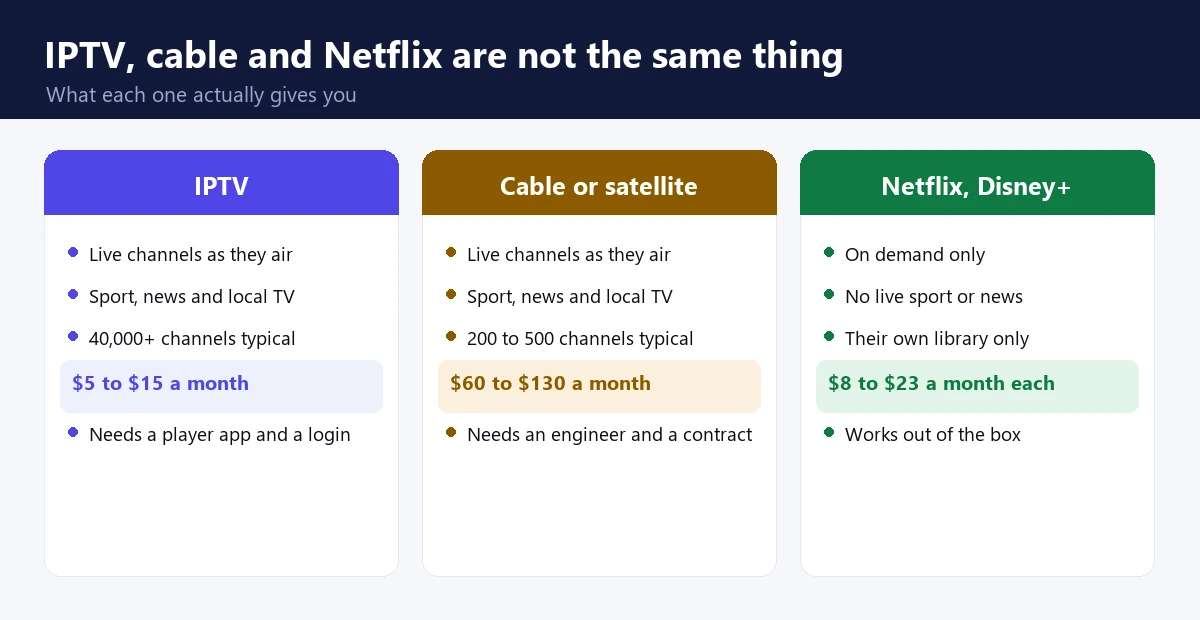
What is IPTV worth against cable? The middle column costs 8 to 12 times more for fewer channels.
People rarely ask what is IPTV out of curiosity. They ask because they are looking at a cable bill and wondering whether there is another way.
There is, and the gap is not small. A cable package running $60 to $130 a month carries 200 to 500 channels, locks you into a contract, and charges equipment rental on top. The same money buys roughly a decade of IPTV.
Streaming services are not really competitors at all. They do not carry live sport, news or local channels, so people who cut cable for Netflix usually end up paying for a live TV add-on anyway.
What is IPTV like to actually use?
What is IPTV like once it is running? The first time is the only awkward part. You install a player, paste 3 fields from an email, and wait about 30 seconds while the channel list downloads. After that it behaves like a television.
You get a grid of channels grouped into categories, a programme guide showing what is on now and next, and a favourites list you build yourself. That last one matters more than people expect. A 40,000 channel list is unusable by scrolling, and 10 minutes spent marking the 20 channels you actually watch turns an overwhelming directory into something that feels normal.
Switching channels takes 1 to 3 seconds rather than being instant, because the player has to request the new stream and fill its buffer. Anyone moving from cable notices this in the first hour and stops noticing it by the second day.
Picture quality on a decent provider is genuinely better than cable, because there is no compression forced by a fixed-bandwidth pipe. Sport in 4K is where the difference shows most clearly.
What is IPTV going to need from you?
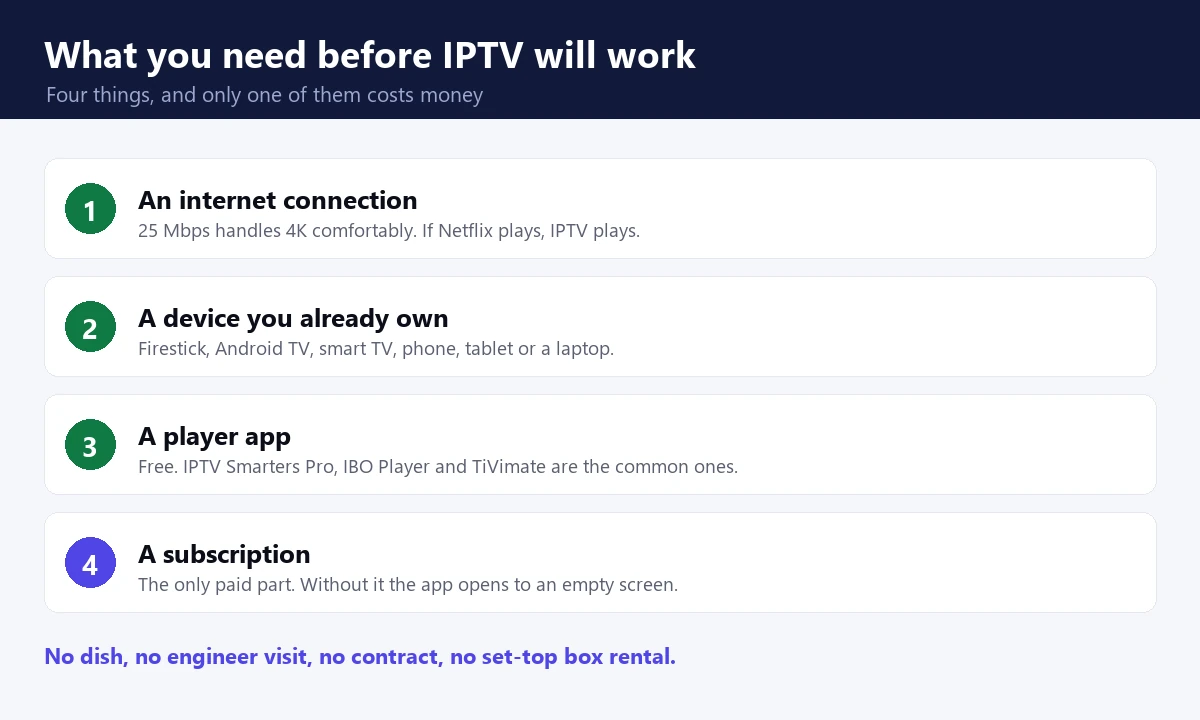
What is IPTV going to ask of you? Four things, and most people already own the first three.
A connection of 25 Mbps handles 4K comfortably. The useful test is simpler than a speed test: if Netflix plays without buffering, your line carries IPTV without buffering. Anyone telling you to upgrade your broadband before subscribing is guessing.
For the device, a Fire TV Stick is the common choice because it is cheap and the apps install easily. Android TV boxes, smart TVs, phones, tablets and laptops all work too. Our guide to the best IPTV boxes covers the trade-offs if you are buying something new.
The player app is free. The subscription is the only part you pay for, and once it is in, our complete IPTV setup guide walks through the first 10 minutes.
Mistakes people make in their first week
Four of these account for nearly every complaint I see, and all 4 are avoidable.
Buying the cheapest listing they find. A $10 yearly plan is not a bargain, it is a line that will stop working. The people who pay twice are the ones who paid $10 first.
Retyping the login instead of pasting it. A trailing space in a username is invisible on screen and the server reads it as part of your name. Copy and paste every field, every time.
Blaming the app. When a stream stutters at 8pm, people reinstall the player. The player is not the problem. Reinstalling changes the buttons, not the server that is overloaded at the other end.
Ignoring the time zone. Set it during setup or the programme guide will show tonight’s football at 3am and you will conclude the guide is broken when it is perfectly accurate for the wrong country.
None of that answers what is IPTV in a technical sense, but it is the difference between a service that feels reliable and one that feels like a scam.
The downsides nobody mentions
No honest answer to what is IPTV is complete without this part, and every competing page leaves it out. So here it is plainly.
It depends entirely on your connection. Cable keeps working when your broadband drops. IPTV does not. If your internet is unreliable in the evenings, IPTV will be unreliable in the evenings, and no provider can fix that from their end.
Quality varies enormously between providers. The technology is standard, so the only thing separating a good service from a bad one is how much they have invested in servers. You cannot tell from the sales page. You can only tell at 8pm on a Sunday when everyone is watching football.
There is a learning curve. You install an app, paste a login, and set a time zone. It is not hard, but it is more than plugging in a cable box, and people who want zero setup will find it annoying.
Small providers vanish. Resellers appear and disappear constantly, taking prepaid subscriptions with them. This is the real risk in the market, and it is an argument for paying slightly more for somebody with a track record rather than chasing the cheapest listing.
Now you know what it is
The cheapest way to find out is 1 month.
Everything above is theory until you watch something on it. A single month costs less than 2 weeks of cable and tells you more about a provider than any review page can.
Just testing? Start with 1 month — $13.99
14-day money-back guarantee
4K quality · 1–4 connections · Works on Firestick, Smart TV, Android, iOS, Mag & Roku
Who is IPTV actually for?
What is IPTV worth to you depends entirely on what you watch. It suits people who watch live television and resent the bill. Sport fans above all, then anyone following news or channels from another country that cable will not carry.
It suits households with more than one screen, because a plan with several connections costs a fraction of a second cable box.
What is IPTV wrong for? Somebody who only watches box sets. If you have not turned on a live channel in a year, a streaming subscription is a better fit and I would say so even standing here. Buying IPTV to watch on demand films is paying for capability you will not use.
If you are weighing providers rather than the technology itself, our comparison of the best IPTV services tests the ones worth considering, and the IPTV FAQs answer the shorter questions. For the underlying technology, the Wikipedia entry on IPTV covers the protocol history in more depth than any buyer needs.
Enjoying iBoostv? Get it for free.
Share your referral link and earn a free month for every person who subscribes. No limit — refer enough people and your subscription pays for itself.
Start earning free monthsFrequently asked questions
What is IPTV in simple terms?
What is IPTV? It is live television carried over your ordinary internet connection rather than a cable, a satellite dish or an aerial. Same programmes, different delivery road.
Is IPTV legal in the USA?
The technology is completely legal. It is a delivery method, like email. Whether a given service is legal depends on the distribution rights that provider holds, so ask them directly what they are licensed to carry.
Is IPTV free to watch?
The player apps are free and there are free public playlists, but they break often because nobody is paid to maintain them. A paid subscription is what buys you servers that hold up at peak time.
Is Netflix included in IPTV?
No. Netflix, Disney+ and Prime Video are closed platforms that cannot be bundled into an IPTV subscription. Any provider showing the Netflix logo is not being straight with you.
Can I get IPTV in the USA?
Yes. It works anywhere with a stable connection. Two American quirks: some internet providers block portal addresses, and regional sport blackouts still apply because those come from the rights holder.
How much does IPTV cost a month?
Between 5 and 15 dollars from anyone running real servers. iBoostv works out at 5.00 dollars a month on the 12 month plan. Cable runs 60 to 130 dollars for fewer channels.
